The Rediscovery of Marinella Pirelli: Beyond the screen
By Glesni Trefor Williams
Archivio Aperto is the annual Italian film festival dedicated to rediscovering small-format film heritage, including private, amateur, experimental, and artists’ cinema. As is often the case for women artists from the 1960s and throughout the history of art, their work and even their names were frequently ignored, forgotten and left to the ravages of time. For the festival’s 18th edition, the programme highlighted the experimental cinema and art of, for the most part, forgotten Italian visual artist Marinella Pirelli (1925-2009) on the centenary of her birth, bringing awareness to her pioneering practice.
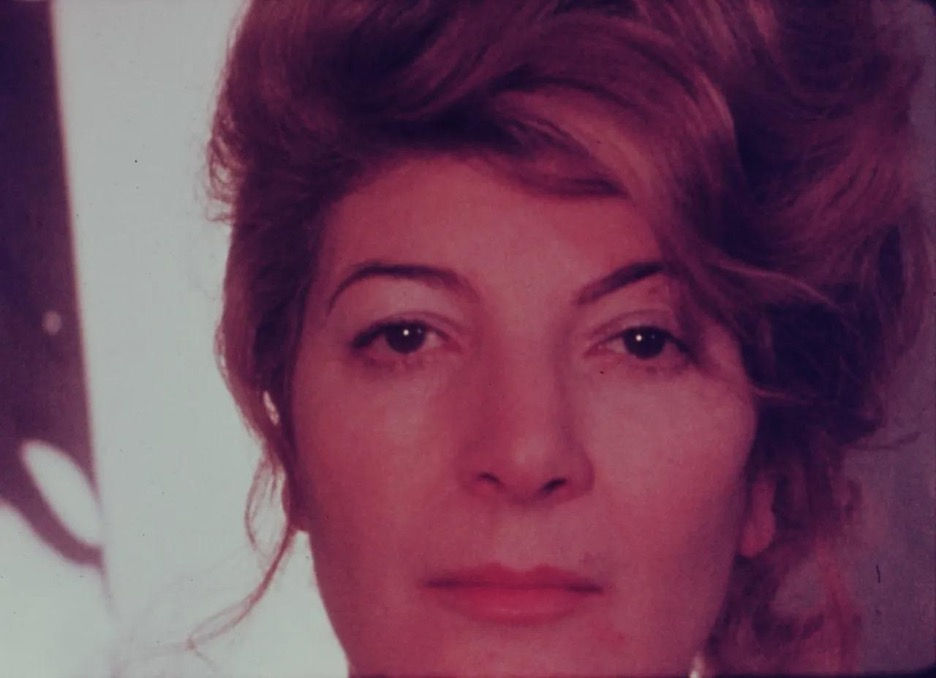
Pirelli’s cinema and visual experiments sought to dissolve the boundaries between observation and experience, the sensual and the existential, and between the roles of director, performer, and spectator. Her practice expanded beyond the screen, creating open, variable, and interactive environments. Yet her name in the history of art and cinema is often pushed aside.
Marinella Pirelli, né Marinelli, was born in 1925 into a progressive family in Verona, Italy. Through the painter Romano Conversano (1920-2010) and his studio, a young Marinella spent time with artists Emilio Vedova (1919-2006), Tancredi Parmeggiani (1927-1964), Beniamino Dal Fabbro (1910-1989) and Rodolfo Sonego (1921-2000). She later moved to Padua, Italy, to initially study literature; however, she decided to leave the Bachelor’s degree and pursue painting, exhibiting her works in the 1950s alongside other emerging names. However, by the early 1960s, she grew increasingly disillusioned with the limits of traditional painting, feeling static in its expressive nature. The canvas no longer seemed sufficient for her exploration of perception, light, and movement. In 1951, Pirelli decided to move to Rome, a city very much in love with cinema, so it was no surprise that, around this time, she became interested in the cinematic arts, not as a narrative or commercial medium, but rather a tool to study the interplay of light, colour, and form; it was much like painting come to life. Pirelli worked for the production company, Filmeco, where she was exposed to the practical side of film.

She was one of the few Italian women artists working in experimental film, and her works traverse numerous themes connected to the body and how it is thus viewed, i.e., the gaze, all through 16mm film. Pirelli’s artistic ambitions also extended beyond the cinema screen. In the late 1960s and early 1970s, she began creating immersive environments that invited viewers to actively participate in and become part of the works. Her most famous piece from this period, Film Ambiente (1969), was conceived as a cinema environment. Visitors entered a space where moving images were reflected and refracted through transparent panels, mirrors, and colored lights. The spectator’s movement through the installation altered the space, dissolving the boundary between artwork and audience. This radical approach anticipated later developments in installation and participatory art, positioning Pirelli as a pioneer of expanded cinema.

Pirelli’s work was profoundly shaped by her consciousness as a woman artist working in a male-dominated sphere. The late 1960s and 1970s were years of personal and political awakening in Italy. Around this time, she became friends with Carla Lonzi (1931-1982), the art critic and feminist thinker who would go on to co-found the Rivolta Femminile collective and write Autoritratto (1969), an anti-authoritarian essay that critiques art criticism and explores the emerging feminist perspective. “If Carla Lonzi provides us with the key to understand that the self-portrait is not about the artists she interviews, but about herself thanks to her photos from her life published in the essay Autoritratto from 1969, Pirelli anticipates with her experiments on film that the self-portrait is accomplished in starting from oneself and from one's own body” (Luce. Movimento. Il cinema sperimentale di Marinella Pirelli (Museo del Novecento, Milano, 22 March – 25 August 2019), Milan, Electa, 2019). Lonzi became the subject of one of Pirelli’s works titled Indumenti (1966), where the Italian artist Luciano Fabro (1936-2007) takes the imprint of Lonzi’s breast on a piece of paper, draws a circle with a pencil, cuts it out and forms a cone by closing it with a pin. This short film, shot entirely on 16mm, is an intimate and delicate piece surrounding the simplicity of documenting artistic gestures and the agency of the female body.

Despite her contributions, Pirelli’s work was largely overlooked by the male-dominated art and film worlds of her time, her contemporaries such as Mario Schifano (1934-1998), Michelangelo Pistoletto (b. 1933), and Jannis Kounellis (1936-2017). Her career was also interrupted in 1974, when she withdrew from public life shortly after the sudden death of her husband, Giovanni Pirelli (1918-1973). Her 16mm films only came to light again forty years later, where her works became the focus of a retrospective at the Museo del Novecento in Milan in 2019, her revival and attention are very much a discovery. Too often, narratives of experimental film in Italy center on male figures such as Paolo Gioli (1942-2022), recognized as Italy’s most important postwar experimental filmmaker, while women’s contributions are pushed to the side. Yet, the history of experimental cinema is incomplete without recognizing the women who expanded its language. Pirelli’s practice bridges the personal and the political, the domestic and the societal. By bringing the body, the home, and the self into dialogue with technology and abstraction, she reframed what cinema could be and for whom it could exist.